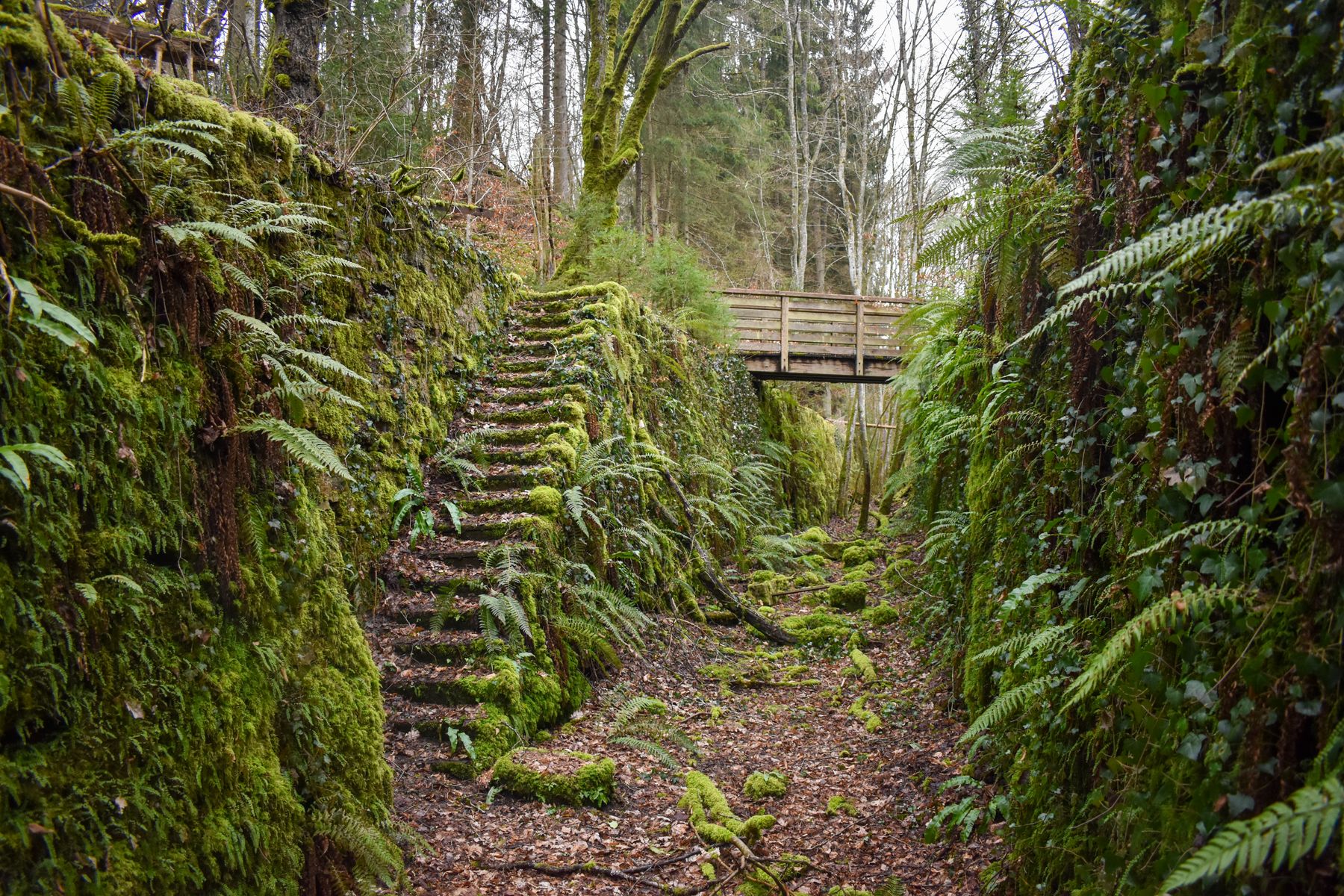
Which Escapardenne trail suits a late-autumn walk
The Escapardenne is two long-distance routes, not one. The Éislek trail runs roughly 106 km between Kautenbach in Luxembourg and La Roche-en-Ardenne in Belgium, through Clervaux, Wiltz and the Our valley. The Lee trail covers about 53 km from Kautenbach north through Hoscheid to Bourscheid-Moulin, close to the Bourscheid castle viewpoint. Late October and November suit the Lee better: shorter stages, more frequent villages, and easier bail-outs if weather turns. The Éislek rewards fitter walkers who accept a three- or four-day commitment with a car or bus shuttle at the Belgian end.
Daylight is the constraint. Sunset in Luxembourg falls before 17:00 through most of November, so plan on six hours of usable walking and keep stages to 15–18 km rather than the 22–25 km the summer route descriptions assume. Trails run on forest tracks, field paths and some paved lanes, with the red-white-red markers of the Réidener Naturpark and the Escapardenne waymarking. Wet leaves on the Éislek's schist and slate are genuinely slippery on descents into the Sûre and Our valleys; poles earn their weight. Gaiters help on the leaf-covered single track.
Getting there, stage by stage, by train and bus
Kautenbach is the hinge of both routes and has a railway station on the Luxembourg–Troisvierges line, so you can start walking straight off a train from Luxembourg City in around 50 minutes. Clervaux and Wiltz are also on the network and make sensible overnight stops. For the Lee trail, buses from Ettelbruck connect Hoscheid and Bourscheid; services thin out after about 18:00, so check the current timetable before you commit to a late finish. On Sundays and public holidays, regional buses run less often than on weekdays.
A realistic Lee itinerary in late autumn: Kautenbach to Hoscheid (about 17 km), Hoscheid to Bourscheid-Moulin (about 18 km), with a short climb out to the castle ruins if the weather holds. For the Éislek, split Kautenbach–Wiltz (about 20 km), Wiltz–Clervaux (about 20 km), then Clervaux onwards into Belgium, arranging a taxi or bus from La Roche-en-Ardenne back towards Bastogne for rail connections. Walk the Belgian section only if you have a full day and settled weather, because onward transport from La Roche is awkward on Sundays.
What the season gives you, and what it takes away
Late autumn is quiet. The Éislek's viewpoint platforms, the Belvédère at Bourscheid and the forest paths around Clervaux are largely free of the summer walking groups, and the Ardennes haze in the valleys photographs beautifully from mid-morning. Mushroom season brings foragers out, and the beech and oak woods above the Our turn copper before the first hard frosts. Hunting is active in Luxembourg's forests from autumn; if you hear shots or see posted signs, keep to marked paths and avoid dawn and dusk in remote blocks.
What you lose is services. Several rural cafés and gîtes along both routes close from early November, the Luxembourg school holidays end in early November, and some hotels in Wiltz and Clervaux reduce midweek opening. Book beds in advance even in low season, especially Thursday to Sunday. Pack for 2–8°C mornings, rain on two days in three, and mud that never quite dries. I would book the Lee trail between the last week of October and mid-November, then use the Éislek for a shorter two-night taster out of Kautenbach.
Where to base yourself and what to skip
Luxembourg City is a strong base for the first and last nights if you arrive by air: the Kirchberg and Gare districts have the widest choice, and trains to Kautenbach, Clervaux and Wiltz leave from the main station. For the walking itself, sleep in Kautenbach or Wiltz for the Éislek and in Bourscheid or Ettelbruck for the Lee. Clervaux is the most rewarding overnight — the abbey, the castle and a handful of restaurants within a few streets — but rooms are limited, so it pays to reserve early.
Skip the temptation to drive between stage ends each evening: it adds an hour or more of dark road time on the N7 and N12 and you lose the point of a linear trail. Skip the full Éislek in a November week unless you are comfortable with 20 km days in rain and a long transfer from Belgium. If you only have two nights, base in Clervaux, walk the looped paths around the town and the Our valley, and use the train for a day on the Lee trail. Check current opening times with the tourist offices in Clervaux and Wiltz before travelling.
Hotels in Bourscheid
Questions, answered
When is the best time for late-autumn walking on the Escapardenne?
Late October to mid-November, before hard frosts and early snow on the higher Ardennes sections. Daylight lasts until just before 17:00 and most summer walkers have gone. Expect wet leaves, mud and two rainy days in three.
Do I need a car to hike the Escapardenne?
No. Kautenbach, Clervaux and Wiltz are on the Luxembourg rail network, and buses link Ettelbruck with Hoscheid and Bourscheid. A car helps at the Belgian end near La Roche-en-Ardenne, where onward public transport is limited and awkward on Sundays.
How long are the stages in late autumn?
Plan 15–18 km days rather than the 22–25 km suggested in summer guides, because sunset arrives early. Kautenbach to Hoscheid is about 17 km, Hoscheid to Bourscheid-Moulin about 18 km, and Kautenbach to Wiltz roughly 20 km.
Where should I stay for the Lee trail?
Bourscheid and Ettelbruck are the practical bases, with Ettelbruck offering the most rooms and rail connections. Bourscheid suits walkers who want to finish near the castle viewpoint. Book ahead even in low season, as rural accommodation reduces midweek opening in November.
Is hunting a concern in Luxembourg forests in autumn?
Hunting is active in autumn. If you hear shots or see posted signs, stay on marked paths and avoid remote forest blocks at dawn and dusk. Wearing something visible and keeping to the waymarked Escapardenne route is sensible common practice.
Which end of the Éislek trail is easier to reach?
Kautenbach, on the Luxembourg side, is easiest: trains from Luxembourg City take around 50 minutes. La Roche-en-Ardenne in Belgium is the harder end, requiring a taxi or bus towards Bastogne for onward rail, and connections are thin at weekends.
What should I pack for November on the Escapardenne?
Waterproof jacket and trousers, boots with grip for wet schist and leaves, trekking poles, gaiters, a head torch, and layers for 2–8°C mornings. Add a paper map or downloaded offline maps, because phone signal is patchy in the Our and Sûre valleys.
Can I combine a city stay in Luxembourg with the trail?
Yes, and it works well. Spend the first and last nights in Luxembourg City's Gare or Kirchberg districts for the widest hotel choice and easy rail access, then move to Clervaux, Wiltz or Bourscheid for the walking stages.
Doing good is the business: every booking through Stay Luxembourg funds one verified tonne of carbon removal — same room, same price, no markup.
Start Your Search