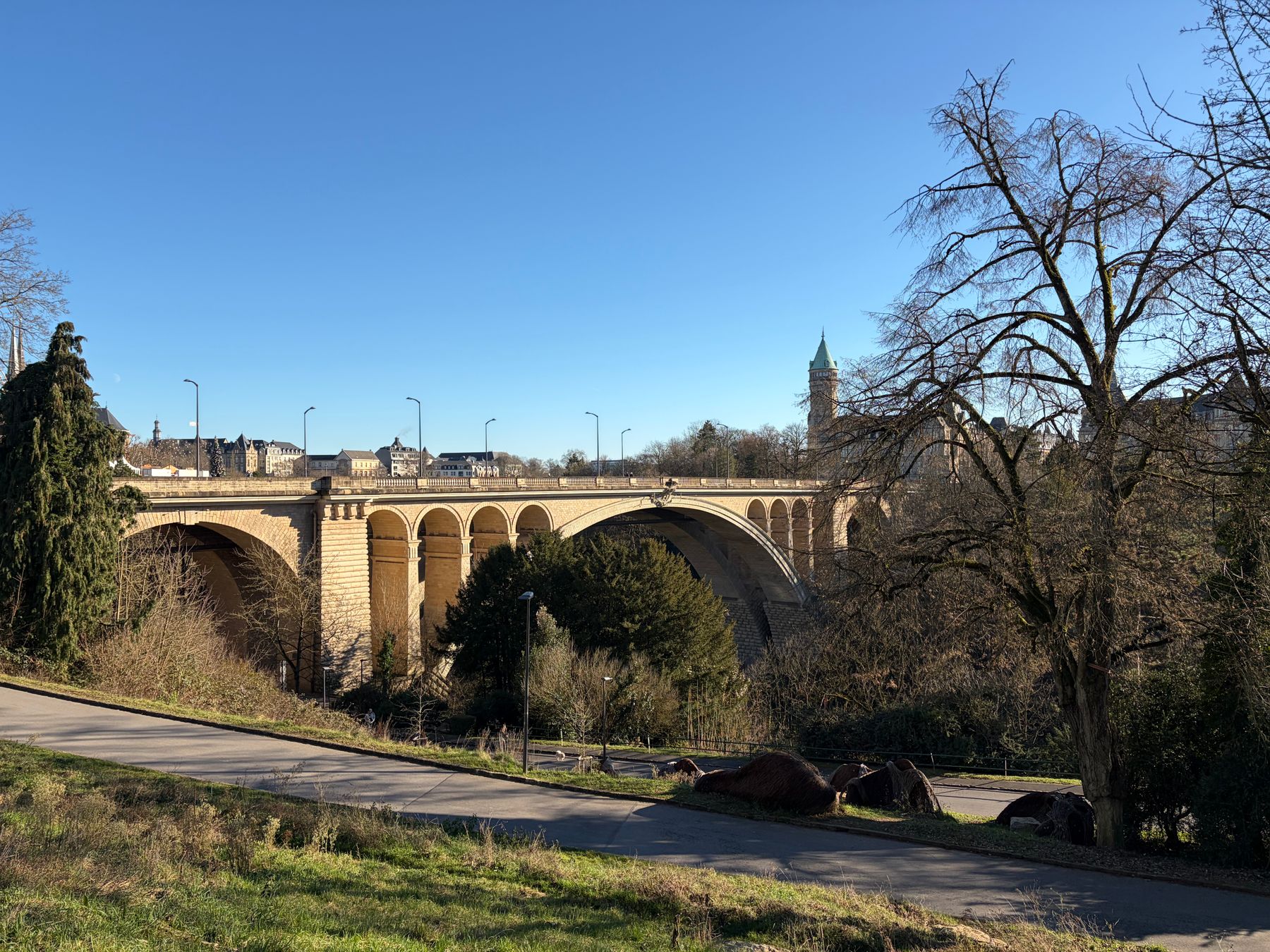
Start in the Ville Haute, where the rain matters least
The old town sits on a plateau between the Pétrusse and Alzette valleys, and almost everything worth seeing on a wet Saturday is within 15 minutes on foot of Place d'Armes. Begin at the Mudam and the Musée national d'histoire et d'art on rue Wiltheim in Clausen, then cut back over the Passerelle viaduct into the Ville Haute. The covered Marché-aux-Poissons area and the Grand Ducal Palace are a five-minute walk apart, so a shower costs you a doorway, not a taxi.
Base yourself in the Ville Haute or Gare district rather than Kirchberg. Hotels around Place de Paris and rue de Strasbourg sit a short walk from the station and its buses into town, while upper-town properties near rue de la Liberté put you on the doorstep of the museums. Rates in the capital generally climb through the week, so a Friday-to-Sunday stay booked well ahead tends to be the calmer option; check the hotel listings on our site for current availability rather than relying on last-minute walk-ins.
Underground and under cover: fortifications, casemates and markets
The Bock casemates are the obvious rainy-day win: a network of tunnels carved into the sandstone under the old fortress, entered near rue Sigefroi, dry and surprisingly warm. Book a timed slot online in the morning because capacity is controlled. Afterwards, walk ten minutes to the Chemin de la Corniche; even in drizzle the view over the Grund is the reason most people come, and the covered arcades along rue du Saint-Esprit give you somewhere to wait out a squall.
For a slower afternoon, the covered halls of the Marché Central on rue Glesener and the surrounding Gare quarter work well: cheese counters, bakeries and a handful of Portuguese and Italian delis that make a long lunch easy. In December, the Christmas markets on Place d'Armes and Place de la Constitution fill the same gap, with wooden stalls under awnings. If you are travelling with children, the Natural History Museum on rue Münster in the Grund is compact and genuinely absorbing for two hours.
Eating, drinking and the things worth skipping
Reserve lunch rather than dinner. Wet weekends push everyone indoors at the same time, and tables in the Grund and Clausen — around rue de la Loge and the abbey quarter — fill between 12:30 and 14:00. Luxembourgish cooking is hearty and suited to the weather: judd mat gaardebounen, bouneschlupp, and pastries from the bakeries near Place Guillaume II. Budget mid-range for a sit-down lunch and keep dinner casual; the capital's restaurant prices sit above neighbouring Metz or Trier.
Skip the open-top city bus tour and the Pfaffenthal panoramic lift if the cloud is low — you pay for views you will not get. Skip, too, a day trip to Vianden in heavy rain; the drive takes about an hour each way and the castle walk is exposed. Better to stay local and use the free public transport to reach Mersch or Ettelbruck for an afternoon if you want a change of scene. The Moselle vineyards are a spring and autumn pleasure; in a wet February they are simply muddy.
May, June and September remain the best months overall, but a rainy weekend in the capital is workable in any season as long as you plan around indoor sights. Book a hotel in the Ville Haute or near the Gare, keep one flexible afternoon, and let the weather decide between casemates and museums.
Where to stay and how to move around
Public transport across Luxembourg has been free since 2020, including the buses and trains that link Findel airport, the Gare and the city centre, so a wet arrival costs you nothing extra. From the airport, the number 16 bus reaches the Gare in roughly 20 minutes. If you are arriving by train from Metz or Trier, the Gare district is the practical base; if you want the old town on foot, pay a little more for the Ville Haute.
Compare the two before you book: Gare hotels are generally simpler and closer to the station, while Ville Haute properties trade convenience for atmosphere and a shorter walk to the museums. Neither area is far from the other — about 20 minutes on foot through the Pétrusse valley, or a few stops on the free bus. For a two-night rainy stay I would take the Ville Haute, keep a collapsible umbrella in the bag, and treat the Grund as an evening walk rather than a planned excursion.
Questions, answered
What can you do in Luxembourg City when it rains?
Head for the Bock casemates, the Mudam and the National Museum of History and Art, all in or near the old town. The covered halls around the Gare and the arcades on rue du Saint-Esprit give you dry places to eat and wait out showers.
Do I need to book museum tickets in advance?
For the Bock casemates, yes — entry is timed and capacity is limited, so reserve online on the morning of your visit. Most museums in the capital accept walk-ins, though a timed slot saves queuing on a wet Saturday afternoon.
Which neighbourhood is best for a rainy weekend stay?
The Ville Haute puts the museums, Place d'Armes and the Grand Ducal Palace within a short walk. The Gare district suits train arrivals and costs less. Both connect easily, since public transport in Luxembourg is free.
Doing good is the business: every booking through Stay Luxembourg funds one verified tonne of carbon removal — same room, same price, no markup.
Start Your Search