Where to Photograph Luxembourg City in Autumn: Seven Viewpoints Worth the Walk
A practical guide to the bridges, ramparts and terraces where low autumn light lands best in Luxembourg City — with walking times, the months that pay off, and what to skip.
The Grund and the Chemin de la Corniche
The classic autumn frame in Luxembourg City is the view down into the Grund from the Chemin de la Corniche, the walkway along the old ramparts on the eastern side of the Haute Ville. From late September the low sun sits behind the city and rakes across the Alzette valley, lighting the slate roofs of the Grund and the Abbey of Neumünster below. Walk the stretch between the Place de la Constitution and the Rham plateau in the hour after sunrise to get mist in the valley and no crowds on the parapet.
The Corniche itself is short — roughly 15 minutes end to end at a photographic pace — so pair it with the descent by the lift in the Plateau du Saint-Esprit or the staircases near the Rue Sosthène Weis. Once down in the Grund, the Rue Münster and the bridge over the Alzette give you the reverse shot looking up at the viaducts. October is the strongest month: the plane trees along the Alzette turn first, and the sun angle is low enough at midday to keep shadows in the valley all day.
Adolphe Bridge and the Pétrusse Valley
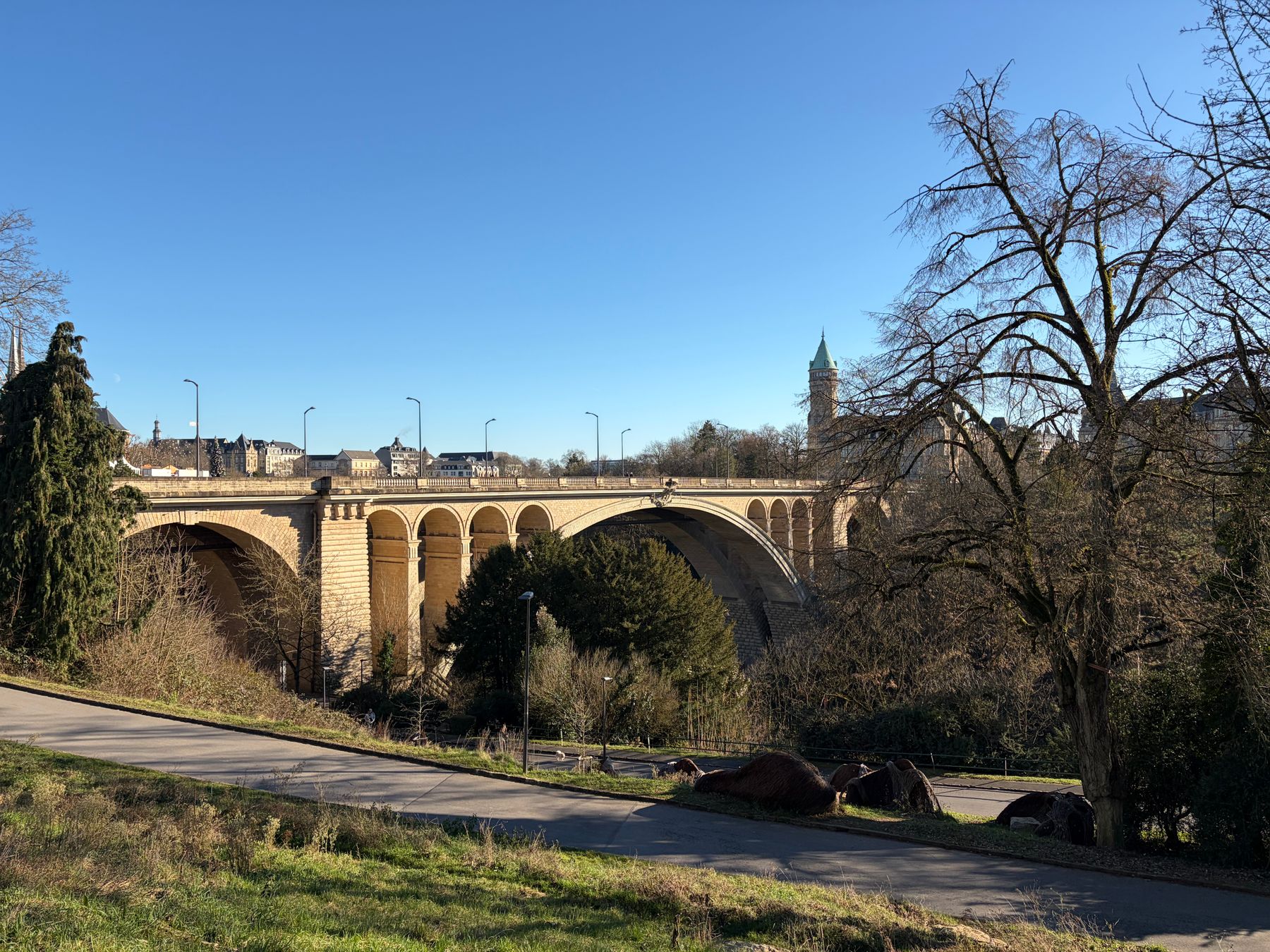
The Pont Adolphe reopened with a separate pedestrian deck, and its northern side looks straight down the Pétrusse valley towards the Pont du Viaduc and the spire of the cathedral behind. In autumn the slopes of the Pétrusse park turn yellow and copper, and the stone arches frame the whole thing neatly. The light is best from mid-morning until about 14:00, when the sun clears the Haute Ville and reaches the valley floor. Come back after dusk for the lit arches reflected in the river.
A second, quieter option is the terrace beside the Gëlle Fra monument on the Place de la Constitution, right at the mouth of the Pétrusse. From here you can shoot down the valley with the Adolphe Bridge in the frame without standing on it. The Promenade de la Pétrusse, the path along the valley floor, is open and gives a view upward at the bridges — useful in November when leaves are down and the structure reads more clearly against the sky.
Kirchberg, the Three Towers and the View Back
For an autumn panorama that includes the whole old town, cross to the Kirchberg plateau. The raised ground near the Philharmonie and the sloping paths around the Parc Klosegrënnchen look south-west across the valley to the Haute Ville skyline: the cathedral, the Corniche, the Adolphe Bridge. Late afternoon is the moment, roughly from 16:00 in October, when the sun drops behind the city and the limestone of the fortifications goes gold. Take tram T1 from the Gare or from Place de l'Étoile; it runs every few minutes and takes about 12 minutes from the station.
The other end of Kirchberg — the wooded slopes above the Rue des Bruyères towards Neudorf — is less spectacular but far emptier, and good for backlit foliage and the towers of the European institutions rising out of the trees. Skip the area around the Grande-Duchesse Charlotte bridge at midday: the sun is behind the city and everything turns flat. Bring a longer lens here; 70-200mm covers the compression of the skyline far better than a wide angle.
Fort Thüngen and the Plateau du Rham
The Rham plateau, just east of the Corniche, offers the most photogenic autumn foliage in the city: dense trees below the old fortifications, the Wenzel wall running along the top, and the three towers of Fort Thüngen at the far end. From the Rham you look back across the Alzette to the Grund and up to the Haute Ville. It is a 10-minute walk from the Bock casemates, and early morning fog off the river is common from late October into November — the best conditions for layered shots of the towers.
Fort Thüngen itself, with the Mudam and the Musée Dräi Eechelen beside it, is worth an hour in the rain: the courtyard trees frame the towers, and the covered passages let you keep shooting when the weather turns. November here is underrated — bare branches open up the geometry of the fortifications and the light is softer than in September. Do not bother with the view from the Platz der Demokratie in the centre; the trees close it off completely by mid-October.
Practical Timing and Where to Stay
Autumn light in Luxembourg runs from roughly 08:00 to 18:30 in late September, shrinking to 08:30 to 16:45 by mid-November. Peak colour on the Alzette and Pétrusse is usually the second half of October; the Kirchberg beech woods run a week or so later. Rain is frequent — bring a weather-sealed body and a cloth, and plan indoor stops at the Mudam or the Casemates du Bock for the wettest hours. Distances between the Corniche, the Pétrusse and the Rham are all under 15 minutes on foot, so you can cover three viewpoints in a morning without transport.
For a photographic trip, base yourself in the Haute Ville or around the Gare. The old town puts the Corniche, the Bock and the Rham within a 10-minute walk; the Gare area is cheaper, has frequent buses and trams into the centre, and is a 12-minute tram ride to Kirchberg. If you want sunrise mist over the Grund without an early walk, the Ville Haute is the one I would book. Search availability for your dates and check whether your hotel offers late checkout — useful on the December mornings when the light comes late.
What to Skip
Skip the Midi district and the station forecourt for any kind of landscape work; it is traffic, glass and street furniture, and the light is blocked by buildings most of the day. Skip the Pfaffenthal lift viewpoint at midday unless you are shooting the lift itself — the valley is in shadow from about 11:00. The Parc de Merl is pleasant but photographically ordinary; the forest at Bambësch north of the city gives better autumn colour if you have a car. And do not plan around a single day in October — build in two mornings so a rainy one does not cost you the trip.
Related articles
Questions, answered
When is the best time to photograph autumn colours in Luxembourg City?
The second half of October is usually peak for the Alzette and Pétrusse valleys, with the Grund plane trees turning first. Kirchberg's beech woods run about a week later, into early November. Late September still has green leaves but the best sun angles.
How long does it take to walk the Chemin de la Corniche?
Fifteen minutes at a normal pace, though photographers should allow 45 minutes to an hour with stops. It runs from near the Place de la Constitution to the Rham plateau, and you can extend it down into the Grund via the Saint-Esprit lift or the staircases near Rue Sosthène Weis.
Do I need a car to reach Luxembourg City's viewpoints?
No. The Corniche, Adolphe Bridge, Pétrusse, Rham plateau and Bock are all within 15 minutes' walk of each other in the centre. Kirchberg is a 12-minute tram ride on T1 from the Gare. A car is only useful for the Bambësch forest north of the city.
Where can I photograph the city skyline in one frame?
The raised ground near the Philharmonie on the Kirchberg plateau, and the paths around the Parc Klosegrënnchen, look south-west across the valley to the cathedral, Corniche and Adolphe Bridge together. Late afternoon from about 16:00 in October is the best light.
Which neighbourhood should I stay in for photography?
The Haute Ville puts the Corniche, Bock and Rham within a 10-minute walk and is best for sunrise mist in the Grund. The Gare area is cheaper, well connected by tram and bus, and only 12 minutes from Kirchberg. I would book the old town if the budget allows.
Is November too late for autumn photography here?
Not at all. Bare branches open up the geometry of the fortifications, the light is softer and rain brings reflective surfaces on the cobbles. Fog off the Alzette in early November is common, which suits the Rham plateau and Fort Thüngen especially.
What equipment should I bring for autumn in Luxembourg City?
A weather-sealed body and a cloth are essential — rain is frequent. A 24-70mm covers the Corniche and valley views, while a 70-200mm is far better for compressing the skyline from Kirchberg. A small tripod helps for dusk shots of the lit Adolphe Bridge.
Are the viewpoints accessible in wet weather?
The Corniche, Adolphe Bridge deck and Rham plateau paths are paved and walkable in rain, though the Pétrusse valley floor can be muddy. For heavy showers, the Mudam, Musée Dräi Eechelen and the Bock casemates offer cover near the main viewpoints.
Doing good is the business: every booking through Stay Luxembourg funds one verified tonne of carbon removal — same room, same price, no markup.
Start Your Search